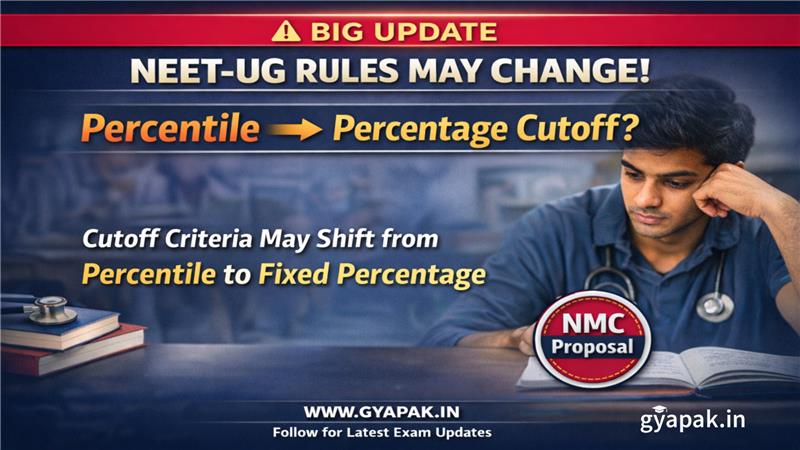
NEET-UG Rules May Change: NMC Considers Percentage Cutoff Instead of Percentile

Insansa Techknowledge Pvt. Ltd.
India’s medical entrance examination system could soon witness a significant transformation. The National Medical Commission (NMC) is reportedly considering a shift from the existing percentile-based cutoff to a percentage-based cutoff for the NEET-UG.
If implemented, this reform could change not only how students qualify but also how they prepare for one of India’s most competitive exams.
Understanding the Current NEET-UG Cutoff System
At present, NEET-UG follows a percentile-based cutoff system, where qualification depends on a candidate’s performance relative to others.
Current qualifying percentiles:
- General category: 50th percentile
- OBC/SC/ST: 40th percentile
- PwD (General): 45th percentile
This means:
The cutoff marks vary every year depending on:
- Difficulty level of the exam
- Number of candidates appearing
- Overall performance
For example, in a tough paper, even lower marks can secure qualification, while in an easier paper, the cutoff tends to rise.
What Is the Proposed Change?
The NMC is now exploring the idea of introducing a fixed percentage-based cutoff system, where:
- Students must score a minimum percentage of total marks
- Qualification will be based on absolute performance
- The cutoff will remain more stable and predictable
This would mark a fundamental shift in the evaluation approach—from relative ranking to fixed academic standards.
Key Reasons Behind the Proposal
1. Ensuring Minimum Academic Standards
One of the major concerns with the current system is that students with relatively low marks can still qualify due to percentile normalization.
A percentage-based system would ensure that every qualifying student meets a minimum level of subject knowledge.
2. Rapid Increase in NEET Aspirants
In recent years, NEET-UG has seen explosive growth:
- Over 20 lakh candidates appear annually
- Numbers are expected to increase further in upcoming cycles
This surge has created intense competition and raised questions about maintaining quality in medical education.
3. Large Number of Qualified Candidates
Under the percentile system, nearly half of the candidates qualify, which:
- Increases pressure during counselling
- Leads to intense seat competition
- Makes filtering of candidates less effective
A percentage cutoff could reduce the qualifying pool, making the process more streamlined.
4. Alignment with Academic Evaluation Systems
Most academic systems in India (like boards and universities) rely on percentage-based evaluation.
Introducing a similar system in NEET could bring uniformity and clarity.
Percentile vs Percentage: A Detailed Comparison
| Aspect | Percentile System | Percentage System |
| Basis | Relative performance | Absolute marks |
| Cutoff | Changes every year | Likely more stable |
| Qualification | Fixed % of candidates qualify | Fixed marks required |
| Fairness | Adjusts with difficulty | May not adjust |
| Competition | Wider qualifying pool | Narrower pool |
Likely Impact on Students
✔️ 1. Higher Cutoff Pressure
Students may need to aim for significantly higher scores to ensure qualification.
✔️ 2. Reduced Dependence on “Paper Difficulty”
Unlike percentile, where difficulty can work in your favor, the percentage system may not compensate for tough papers.
✔️ 3. Change in Preparation Strategy
Preparation will shift from:
- Rank-focused strategy ➝ to ➝ score-maximization strategy
Students will need:
- Strong conceptual clarity
- Better accuracy
- Improved time management
✔️ 4. Possible Drop in Qualifying Candidates
Fewer students may qualify, which could:
- Reduce counselling pressure
- Improve overall selection quality
✔️ 5. Increased Psychological Pressure
Since the cutoff will be fixed, aspirants may feel:
- More pressure to meet a specific score
- Less flexibility in performance variation
Hypothetical Example
Let’s understand with a simple comparison:
- Current system:
- A score of ~130–150 marks might still qualify depending on percentile
- Proposed system:
- If the cutoff is fixed at, say, 50% marks, the same score may not qualify
This shows how the new system could raise the minimum benchmark significantly.
Expert Opinions and Concerns
Education experts have mixed views on this proposal:
Advantages:
- Improves quality of selected candidates
- Ensures minimum competency
- Brings transparency
Concerns:
- May disadvantage students from weaker backgrounds
- Does not adjust for exam difficulty
- Could increase stress among aspirants
A balanced approach may be required, possibly combining minimum percentage + percentile safeguards.
Is This Change Confirmed?
No, the proposal is still under discussion by the National Medical Commission.
Before implementation:
- Policy approval will be required
- Guidelines will be officially released
- Students will be given time to adapt
Final Thoughts
The proposed shift to a percentage-based cutoff in NEET-UG could reshape India’s medical admission landscape.
While it aims to:
- Improve academic standards
- Reduce excessive competition
It also introduces:
- Higher performance expectations
- Greater pressure on aspirants
For students, the strategy is clear:
Focus on strong fundamentals, consistent practice, and high scoring performance.
Found this helpful? Share it.